
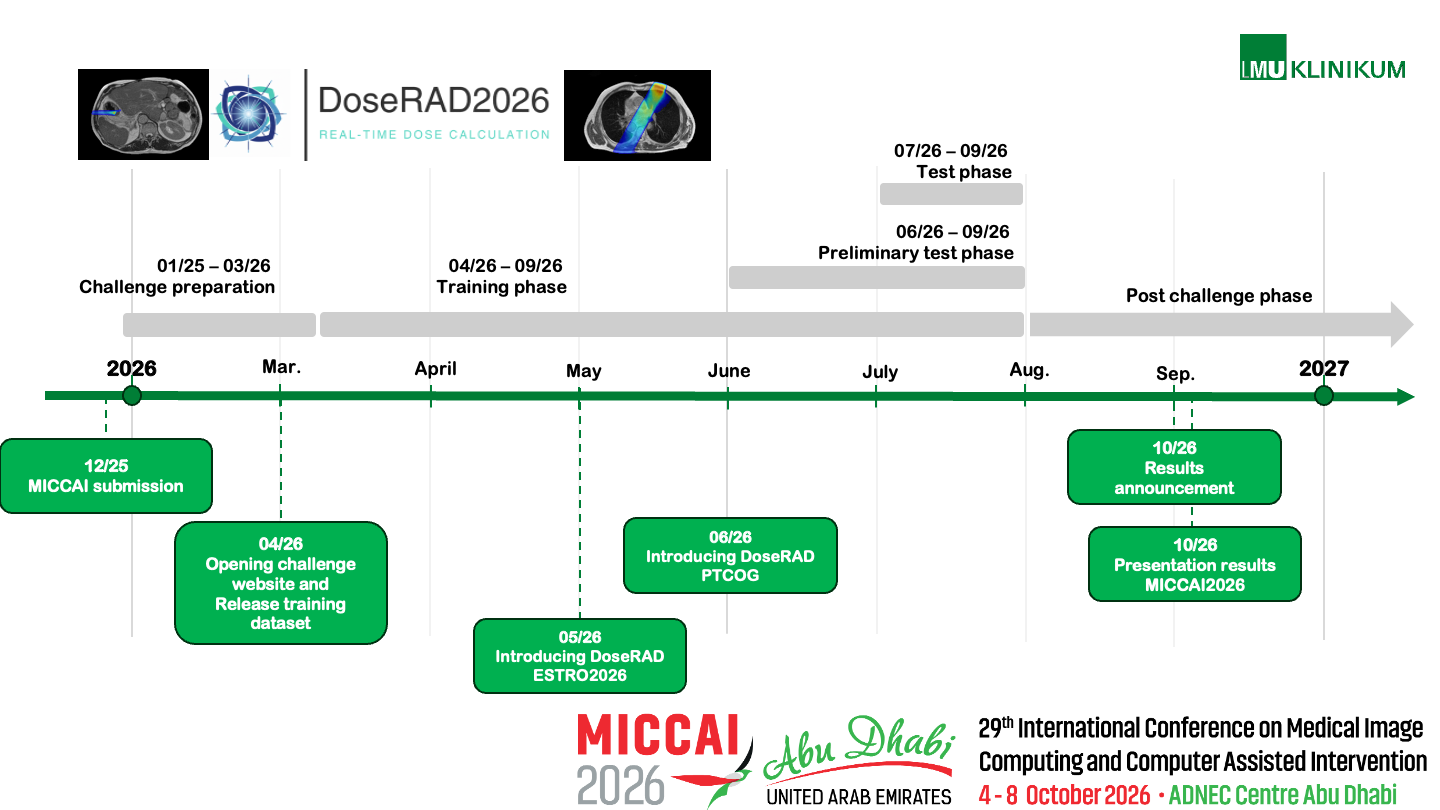
DoseRAD2026 Timeline
- Challenge website officially online 10/04/2026
- Start challenge: Release training cases 10/04/2026
- Training and validation phase (7+13 weeks) 10/04/2026 - 31/08/2026
- Introduction of the challenge at ESTRO2026 15/05/2026 - 19/05/2026
- Preliminary test phase (13 weeks, 10 submissions) 01/06/2026 - 31/08/2026
- Test phase (6 weeks, max 2 submissions) 16/07/2026 - 31/08/2026
- Announcements and invitation to present 15/09/2026
- Presentation of the challenge results MICCAI 2026, Abu Dhabi 4 or 8/10/2026
- Post-challenge phase 15/09/2026-31/12/2026
Rules 📰
ENTRY INTO THIS CHALLENGE CONSTITUTES YOUR ACCEPTANCE OF THESE OFFICIAL RULES.
Every participant must sign up for a verified Grand-Challenge account on www.grand-challenge.org and join the challenge to be able to submit an algorithm.
Only fully automatic methods are allowed. Methods should be submitted as specified on the submission page.
Methods
Only fully automatic methods are allowed. Methods should be submitted as specified on the submission page.
Inference of submitted algorithms should run on an AWS g5 instance using a single GPU with 24 GB GPU RAM, 16 CPUs, and 64 GB RAM. Please select this under the "Job required gpu type" pulldown menu. It is important to select this GPU to ensure consistent algorithm runtime evaluation. Maximum inference time for a single beam must not exceed 1 sec.
One account per participant/team
Each participant/team can only use one account to submit to the challenge. Submissions from multiple accounts will result in disqualification. Teams are limited to five participants.
Use of other training data/pre-trained models
DoseRAD2026 will provide training data. Participants are allowed to use additional data that is publicly available. Participants are also allowed to use publicly available pre-trained models. In either case, the data and/or models must be made publicly available before the start of the challenge on March 15th 2026.
Specifically:
- ✅ Allowed: Using open-source codebases as a reference or for implementation.
- ✅ Allowed: Training a model from scratch using only the permitted datasets.
- ✅ Allowed: Initializing a model with pre-trained weights, as long as they were publicly available before April 10th, 2026.
- ❌ Not Allowed: Fine-tuning a model trained on any private dataset or with private weights that were not publicly available by April 10th, 2026.
The use of publicly available data and models must be reported in a document describing the submitted method and the corresponding submission form.
Code of the submitted algorithm
The top team per task must disclose and openly share their code to allow for future re-use of their algorithms. While all other teams are strongly encouraged to do so, it is not mandatory. The code should be provided within 14 days of the announcement of the winning participants.
Award eligibility
Each team can comprise five participants, but the organizers reserve the right to reduce the number of co-authors of the top-performing teams to the challenge paper summarizing the results (see publication policy). Once a participant or a team submits, the submission or the team cannot withdraw from the challenge.
As further conditions for being awarded a prize, the teams must fulfill the following obligations:
- Present their method in person at the final event of the challenge at MICCAI 2026.
- Submit a paper reporting the details of the methods in a short or long LNCS format, following the checklist provided on the submission page. Organizers reserve the right to exclude submissions lacking any of these reporting elements.
- Submit a form reporting the details of the algorithm after the test submission has been completed, as the organizers will provide it.
- Sign and return all prize acceptance documents as may be required by the Competition Sponsor/Organizers.
- Commit to citing the challenge report and data overview paper whenever submitting the developed method for scientific and non-scientific publications.
- The top four teams must disclose and openly share their code and weights, as well as any additional data generated to set up their algorithms, to allow for future re-use of their algorithms. While all other teams are strongly encouraged to do so, it is not mandatory. The code should be provided within 14 days of the announcement of the winning participants.
Participation policy for organizers' institutes
Members of the organizers' institutes may participate if they are not listed as organizers, contributors, or data providers. If they did co-author any publications with the organizers from 2024-09 to 2026-09 they are not eligible for prizes.
Follow-up publication
The DoseRAD2026 organizers will consolidate results and submit a challenge paper to Medical Image Analysis or similar. The top team for each task and other interesting submissions will be invited to participate in the publication.
Publishing the submitted method elsewhere
Organizers and data providers may publish methods based on challenge data after a 6-month embargo from the final MICCAI event. Participants may submit their results elsewhere after the embargo, unless they cite the overview paper, in which case no embargo applies.